EPK – Cepheidae Variable – Primordial Reverie (2025)
Publicist – Jon Asher – jon[@]ashermediarelations[.]com
“I think this album will have people who enjoy it as a whole piece, but also have two defined groups who are partial to either the first or the second half. I knew during the writing process that my choice might be divisive. I chose to use my own evolution of musical taste as the driving force behind the story and its tonality. Fans of symphonic metal, strong melody, and simpler song structure may enjoy the first half. Whereas those who enjoy a bit of chaos, uncertainty, and sci-fi influences will enjoy the second.
It also makes defining a genre quite difficult. I believe fans of progressive metal can all find elements they’ll enjoy. Not every song will fit the genre definitions of the listener, however, I think the album as a whole will be appealing. I’m trying to create a story through instrumentation. Heavily layered sections with orchestral instruments, synths, and guitars lead us through three distinct acts.
My hope is that fans of the album will appreciate the journey and find new things to enjoy with subsequent listens.” – Ryan Koepke – Cepheidae Variable
For fans of Dream Theater, Haken, Intervals, Wintersun, Caligula’s Horse
Band: Cepheidae Variable
Album Title: Primordial Reverie
Release Date: November 7, 2025
Genre: Instrumental Prog Metal
Label: Self-Release
Distribution: Distrokid
Location: Kelowna, BC, Canada
Cepheidaevariable.com/ | Facebook.com/cepheidaevariable | Instagram.com/cepheidaevariable_official | Tiktok.com/@cepheidaevariable | Youtube.com/@CepheidaeVariable
Spotify | Apple Music | Cepheidaevariable.bandcamp.com | Soundcloud.com/cepheidae-variable
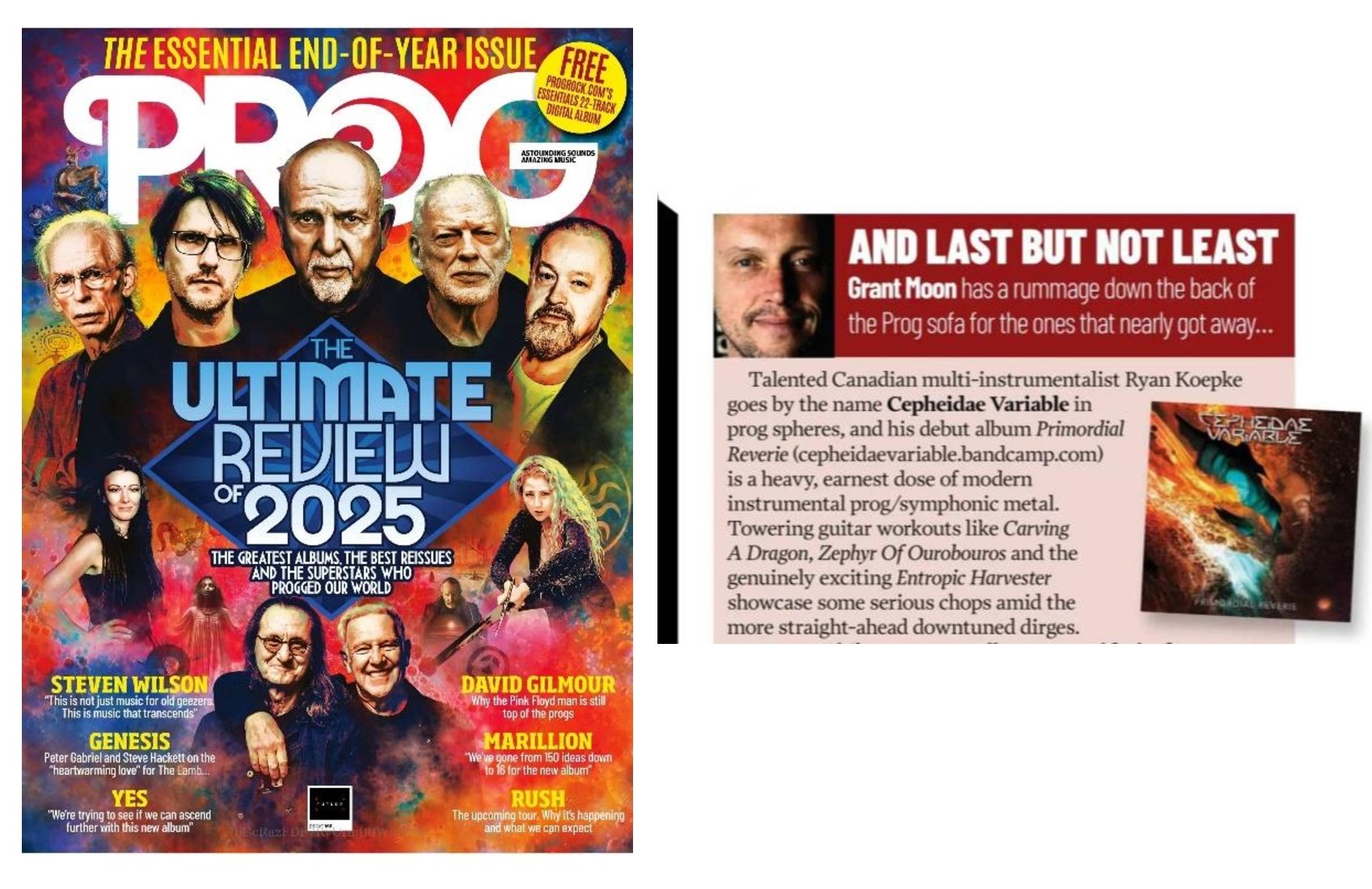 “Talented Canadian multi-instrumentalist Ryan Koepke goes by the name Cepheidae Variable in prog spheres, and his debut album Primordial Reverie is a heavy, earnest dose of modern instrumental prog/symphonic metal. Towering guitar workouts like Carving A Dragon, Zephyr Of Ourobouros and the genuinely exciting Entropic Harvester showcase some serious chops amid the more straight-ahead downtuned dirges.” – Prog Mag
“This was a solid album to listen to. Without vocals, the artist has to work harder to convey his feelings and emotions in his music, and Ryan did that well. Many of the melodies you can hum or sing along with, and that’s a testament to the instrumental album.” – Metal Temple
“This is a well-performed album, great playing and a punch of a production too. Almost a 4 in grading.4/5″ – Melodic.net
“Eerie synths continue guiding us through the portal in the song’s opening, and booming taiko drums signal the significance of the transition, along with brightly dancing, futuristic keys. And then, although those swirling ethereal synths don’t vanish, hard-charging chords add a gritty, pulse-pounding groove, and fleet-fingered fretwork creates an air of jubilant exhilaration. The guitar-work begins to sound darker and more sinister… and then suddenly vanishes… giving way to a dreamlike, celestial interlude. Coming out of the interlude, keys brightly dance again and drums boom — and then the music becomes both more chaotic and, when a breakdown lowers the boom, more pulverizing and more ominous. The pace begins to accelerate again, and the music grows more frantic and unsettling, but the song ends in a phase that sounds both warm and wondrous — and thus concludes the album’s second act before the final act represented in the album’s last three songs. The video is a fun experience as well, intertwining cosmic visions and Ryan’s playthrough performance.” – No Clean Singing
“Combining symphonic textures, sci-fi ambience, and progressive intricacy, Primordial Reverie explores the balance between chaos and melody, emotion and evolution. Through layers of orchestral arrangements, synths, and guitar-driven storytelling, Ryan invites listeners to experience a sonic voyage through creation, transformation, and reflection.” – Crannk
“It’s easy for instrumental metal, and for progressive metal, to lose their emotional punch in a pile of clever passages. Ryan Koepke does an excellent job maintaining poignancy throughout Primordial Reverie‘s hour-ish run time. This album does feel like a singular journey that takes the listener into different emotional headspaces as the music unfolds.” – Metal Utopia
“This instrumental concept album from Canada takes the listener on a journey, led by guitarist and composer Ryan Koepke, delivering songs like “Carving A Dragon” from the mythical world to “Singularity” from the more futuristic realm. The songs combine technical riffs and melodic themes wrapped in partially orchestral arrangements. “The Waiting Storm” is a solid highlight with driving rhythm, catchy riffs, and intensity. It’s usually hit or miss when it comes to vocal-free releases, but this one, with good production, succeeds in conveying the emotional aspect… All in all, a decent debut, and if you like instrumental albums of technical metal with cinematic elements, this is worth checking out.” Scream Magazine
“A solo project by Canadian multi-instrumentalist and producer Ryan Koepke, Cepheidae Variable is an excellent demonstration of the versatile and varied soul of progressive metal: the new album Primordial Reverie features nine instrumental pieces that highlight the Creator’s creativity and the intention to bring to life complex and structured soundscapes. Prevailing is the drive towards experimental arrangements aimed at exploring grandiose and impactful forms; this approach is reflected in orchestral passages, unconventional solutions, or in long suites where the guitar takes a leading role. All of this unfolds on the foundation of meticulous attention to detail and the elegant combination of different instruments. The harmony of sounds and atmospheres that emerges, for instance, from listening to Zephyr Of Ouroboros or Chromatic Haven (certainly two of the most intriguing tracks of the entire album) hits the mark perfectly, offering moments of pure poetry: a mix of technique and inspiration pushed to decidedly high-quality levels, confirming the compositional and interpretative talents of an artist of substance.” – Rock Hard Italy



Band: Cepheidae Variable
Album Title: Primordial Reverie
Release Date: November 7, 2025
Genre: Instrumental Prog Metal
Label: Self-Release
Distribution: Distrokid
Location: Kelowna, BC, Canada
Track Listing:
1. Overture (3:11)
2. Carving a Dragon (4:04)
3. The Waiting Storm (3:13)
4. Zephyr of Ouroboros (9:15)
5. Encounter (5:53)
6. The Conduit (6:03)
7. Chromatic Haven (5:11)
8. Entropic Harvester (10:27)
9. Singularity (11:32)
Album Length: 58:53
Album Credits:
All songs performed by: Ryan Koepke
All songs written by: Ryan Koepke
Produced by: Ryan Koepke
Mixed by: Ryan Koepke
Mastered by: Cole Millward
Album Artwork by: Alex Eckman-Lawn
BMI Member: Writer number 551220753
MAPL: Yes
Band: Ryan Koepke – Guitar, Bass
===================================================
About The Album Artwork:
The album art is a piece by renowned collage artist Alex Eckman-Lawn. My own reaction to this art is a sense of loneliness and wonder. The abstract spatter gives me feelings of space and distant worlds. The flames organically grow off the character’s body, giving an otherworldly feeling to her.
I especially enjoyed this artwork because of the amount of interpretation it allows from the viewer. It was a heavy influence on the tonal shift this album undergoes.
About the album as a whole (LYRICALLY & MUSICALLY):
Primordial Reverie started out as an exploration of my musical tastes as an artist. It quickly developed into a concept of establishing different biomes or “acts” through instrumentation. Void of any lyrics, this challenged my compositional abilities. Each song has a strong identity, and the album flows like a story. The underlying story was largely a visual outline that constantly grew and shifted in my mind. I wanted to leave this up to the imagination of the listener.
The album, from its inception, was meant to be listened to as a complete piece. The intro foreshadows the tonal shift it undergoes as we gradually go from a fantasy feel with natural orchestral elements to more synths and sci-fi elements. We also see an increasing level of complexity and scale as the tracks continue. I start to introduce odd time signatures heavily around “Zephyr of Ourobouros”, and we see a whimsical shift in “Encounter” to establish the sound that develops in the central act of the album.
Something I leaned into quite heavily is the recurrence of certain motifs and the mutation of past rhythm and melody. Most of the tracks undergo a lot of change throughout; however, upon subsequent listens, I think you start to pick up on just how much might be built around a single idea.
Track by Track (LYRICALLY & MUSICALLY):
1. Overture: Overture was the second last piece written for this album. It is the only track that is mostly made up of synthetic elements. Although the main arpeggio theme we hear is played through effects on a guitar. It is meant to foreshadow the sci-fi shift the album undergoes and establish a lot of the themes that develop.
2. Carving a Dragon: Carving a Dragon is one of the simpler tracks. Meant to be catchy and feel like you’re setting out on a journey. The song developed in a way that feels like it’s constantly driving towards something. It is also a demonstration of a more refined version of a track I would’ve written when I was younger. There are a lot of guitar harmonies and layers throughout, and a fairly simple but powerful solo section.
It also has symbolic meaning to me. The title itself was the first thing written for this album. It was derived from the book I was reading at the time, “Assassin’s Quest” by Robin Hobb. I enjoyed the themes developed of pouring your soul into something to give it life. Carving a Dragon is about taking the life I’ve built around music and setting out to create an album I’m excited to have people listen to.
3. The Waiting Storm: The Waiting Storm is the action scene of the album. It is a straightforward track that gets you moving. Other than a brief reprieve in the center, it doesn’t let up. Likely my favorite song to perform on this release. Its main riff is catchy and satisfying, and the chorus sections are very energetic.
4. Zephyr of Ouroboros: Zephyr of Ouroboros is where the album really starts to open up. It is the conclusion to the first act that has been developing. Opening with a windy soundscape and orchestral arrangement, it then goes into an engaging guitar riff that keeps you guessing. We start to see a lot of odd time signatures here, and some additional genre influences.
Violin and guitar interweave to create soaring harmonies. Each section is meant to feel like the leg of a journey. The structure of this song is quite traditional, with orchestration and lead guitar taking over the role of vocals. This allowed me to have a lot of fun in the center section with what would normally be an instrumental break. A bass solo is followed by a two-part guitar solo that eventually winds down into a reprisal of the earlier themes.
The song is also circular in structure. After a final chorus, we have an outro which breaks down the intro riff in reverse, before leading to our orchestral section being rearranged for soft piano over an evocative soundscape. This closes out the song and the first act of the album.
5. Encounter: Encounter is where we start to see a lot of the sci-fi elements that were foreshadowed in the opening track. Layered synths create an operatic melody that gives a feeling of isolation and melancholy. This is quickly shattered by heavy guitar riffing and an introduction to 8-string guitars from here on out.
I was listening to a lot of Haken when I started writing this track. I also received the cover art for the album. These outside influences really shone through here and marked the start of the album’s second act.
Highlights of this track are plucky synths and guitar riffing, creating what can only be described as an alien ho-down. As well as a very fun and whimsical bass and solo section. The outro of this does not resolve and leads directly into what may be my favorite track on the album.
6. The Conduit: The Conduit continues right where Encounter left off. Melancholic synths are soon met with layers of taiko drums and the main theme of the track. When the guitars are introduced, they are accompanied by a floaty, atmospheric harmony.
The driving energy of the song continues with a bit of tension release prior to dropping off into an unexpected synth interlude. This devolves into something darker and more sinister. The main theme comes back mutated before being met with a wall of guitar and blast beats.
More genre influences introduce themselves with a heavy breakdown. This releases into a slow and dissonant build as the tempo steadily climbs. The tension is relieved before going into a heavily layered outro that ends our second act.
“The Conduit” was visualized as a section of the story where the journey takes us through a portal in space that leads us to our final frontier.
7. Chromatic Haven: Chromatic Haven gives us a bit of relaxation after the last track. Opening with a joyous, whimsical synth melody, which is soon met with guitar unison and choppy rhythms. Some more prog rock elements then make their way in with a groovy bass and guitar section.
We then have the driving rhythm behind the start of our final journey. The joy and whimsy are broken as the song takes a darker turn. Heavy guitars are mixed with an atmospheric lead solo and sustained guitar harmony.
The song ends on a cliffhanger. It evokes a similar feeling in me to how “Carving a Dragon” ended. Giving a sense that our final act is underway.
8. Entropic Harvester: Entropic Harvester came from the idea of having a “villain” in an instrumental track. Guitars and synths interweave in a game of cat and mouse throughout. We have an evolving rhythm section followed by chorus sections that introduce new harmony and layering each time they reappear.
The central section goes completely off the rails. Dream Theater, Haken, and Meshuggah influences take over to create a combination of heavy guitar riffing, odd-time, and melody. The first solo leads into a keyboard solo meant to feel like an epic battle. With the Entropic Harvester supposedly defeated, we get a bit of a break with a happy feeling of harmony, which I aptly named “friends” as I was writing. This is soon shattered by an aggressive solo that leads into the song’s outro.
The outro mutates and evolves the themes that have built throughout the song. When you think it’s finally over, we hear the very first part written for this song, the Entropic Harvester shuts down, and we move on to the final leg of the album.
9. Singularity: Singularity was always meant to be the grandest track I’ve written. Writing began quite early in the album’s development. We open with an aggressive spacey-sounding synth section before guitars take over and solidly establish the themes in a strong intro riff.
After a cyberpunk feeling disco party, we go into an orchestral interlude that is heavily mutated from the main theme. This leads into some of the quirkier sections of the album. Rainsticks prelude heavy guitars and a driving guitar solo that trades focus between bass, rhythm, and unison.
The album then comes full circle. Taking the arrangement from “Overture” as our outro. Each synth and string section is given to a guitar or bassline. An emotionally larger-than-life soundscape is created with the use of reverb and moving instrumentation around the stereo field. The asynchronous harmonization creates a grand feeling that clearly defines the album as coming to a close.
Finally, we’re met with a peaceful yet desolate soundscape that gives us a feeling of closure to the album.
=====================================================
FUN FACTS – STORY ANGLES
1. The name “Cepheidae Variable” is a bit of nonsense. I wanted to name the project “Cepheid Variable”; however, I quickly realized every word and combination of words under the sun has been used at this point. So it became a play on words, and now it’s about a family of jellyfish.
2. All guitars, bass, and production are done in my home studio aptly named “Chromatic Variable Soundworks”.
3. Cole Millward performed mastering on this album. We connected after I named him in response to an online post asking who my favorite modern mix/master engineer was.
4. I consider myself a fairly mediocre guitarist. Local musicians have called me a “monster” in praise; however, I’ve never kept it a secret that I struggle to develop on the instrument.
5. I grew up disliking everything to do with metal. There was no local scene for it, and the people I was around thought classic rock was the end stage of musical development. This conditioning was undone when I first heard Dream Theater, and realized the levels that music could be taken to.
=======================================================
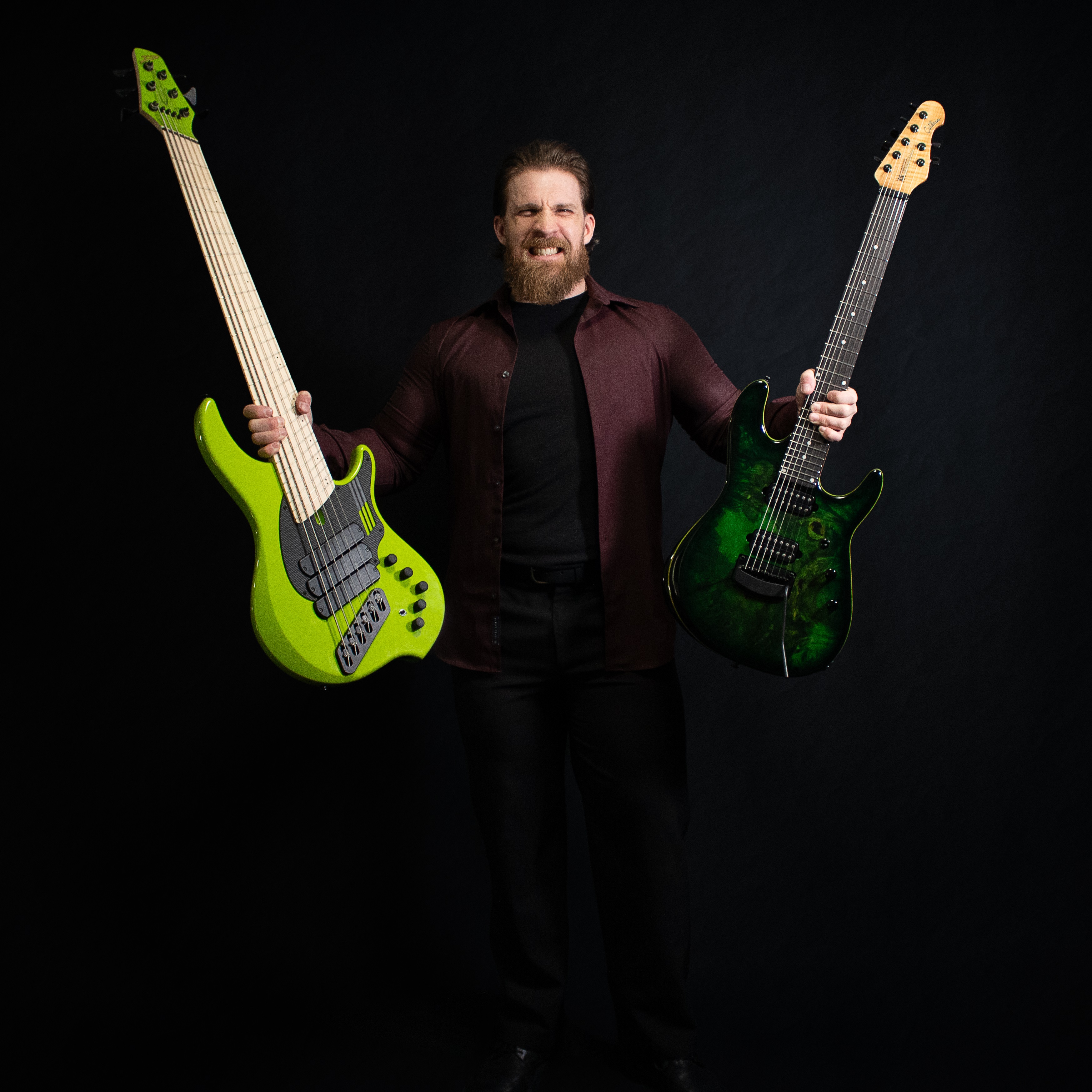
Photo Credit – Solo artist: Ryan Koepke – Guitar, Bass, Composition, Production
Cepheidae Variable is the solo progressive metal project of Canadian (Kelowna, BC) multi-instrumentalist Ryan Koepke, born from a deeply personal journey of transformation, resilience, and artistic evolution. Initially conceived as a casual creative outlet, the project took on new emotional weight following the news of Koepke’s father’s cancer diagnosis. This pivotal moment galvanized him to finally release music publicly after two decades of playing guitar and immersing himself in the local music scene.
The debut album, Primordial Reverie, is a sweeping instrumental odyssey that defies genre boundaries and embraces emotional complexity. Written and recorded entirely by Koepke, the album unfolds like a sonic narrative, divided into three distinct acts that traverse symphonic fantasy, chaotic sci-fi, and introspective melancholy. Drawing from influences like Dream Theater, Haken, Intervals, Wintersun, and Caligula’s Horse, Cepheidae Variable blends progressive metal, melodic death metal, and orchestral textures into a sound that is, by Koepke’s own words, “spacey, weird, melodic, melancholic, happy.”
Each track on Primordial Reverie is meticulously crafted to support the next, forming a cohesive whole that rewards attentive listening. Koepke’s writing process mirrors that of a novelist, beginning with visual themes and emotional arcs rather than isolated riffs or melodies. His compositions often evolve from improvisation into orchestrated complexity, with recurring motifs and rhythmic mutations that echo throughout the album.
The album’s artwork, created by collage artist Alex Eckman-Lawn, reflects the ethereal and otherworldly tone of the music. Its abstract imagery and organic flame-like forms inspired the album’s tonal shift and reinforced the sense of cosmic solitude and wonder that permeates the record.
Singles from the album offer high-energy, standalone experiences, but Koepke encourages listeners to engage with the full album to appreciate its thematic depth and emotional journey. With Primordial Reverie, Cepheidae Variable invites fans into a world of layered instrumentation, evolving soundscapes, and personal storytelling, without uttering a single lyric.
Looking ahead, Koepke plans to release a new full-length album every 2–4 years, potentially expanding the project beyond its solo roots and exploring vocal elements. As both a father and a daughter navigating life’s transitions, Koepke channels his experiences into music that resonates with introspection, imagination, and catharsis.
Cepheidae Variable isn’t just a band, it’s a living archive of one artist’s growth, grief, and creative awakening.

 ashermediarelations.com
Comments
Trackbacks & Pingbacks
No incoming links found yet.